
How to Knit a Round-Yoke Sweater
Knitting a top-down sweater with a round yoke isn't hard at all—here is how both top-down and bottom-up constructions work on circular needles.
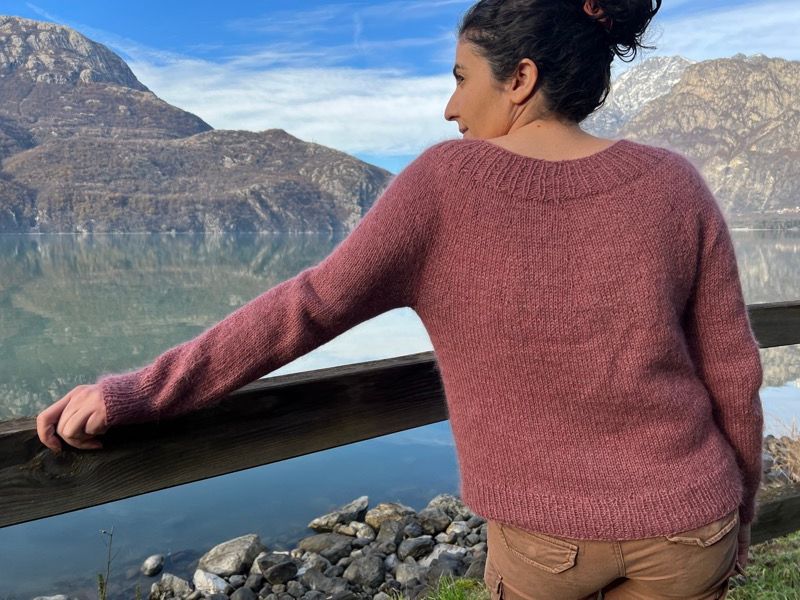
A round-yoke sweater can be knitted either top down or bottom up. In this post, I'm going to walk you through how it's constructed with circular needles.
When we talk about the yoke, we mean the upper part of the sweater, from the neckline down to the armholes.
The armhole is where the sleeve will be "attached"—often it sits right at the underarm, though not always; it can also sit lower, for instance on oversized sweaters.
To shape a round yoke, you work increases (if knitting top down) or decreases (if knitting bottom up) at regular intervals across the rounds. This also makes it easy to add colorwork motifs or special stitch patterns right in that section.
Since I love keeping things simple, I left the yoke plain, as you can see in the photo. Because of that, my Rosita sweater is great even for less experienced knitters!
If you're knitting top down, once the yoke is finished, you place the sleeve stitches on hold and keep knitting the body on a single circular needle all the way down to the hem. Once the body is done, you slip those held sleeve stitches back onto your needles and knit from the armhole down to the cuff.
If instead you're knitting bottom up, the yoke is the last part of the sweater you'll work.
You start with the body and knit all the way up to the armholes. Then you knit the sleeves from the cuff up to the top. Next, you join the body and sleeves onto one needle and begin the yoke decreases, finishing the sweater by binding off at the neckline.
My Rosita sweater is worked top down, and the instructions are written for sizes S, M, L, and XL. For this knit, I used 4mm and 5mm circular needles. You can find more details in the pattern description.
Download the free book "From Zero to Knitter"
Learn to knit the simple way! Over 30 beginner-friendly stitches and 4 easy projects — 170 pages, free PDF.